Earlier this month, new umbrella reform legislation came into effect. At the heart of it, it aims to eliminate non-compliant umbrella companies and prevent exploitation of contractors. Where past regulations in this space have focused on determining the contract status (inside vs. outside IR35), the new changes focus on payment security.
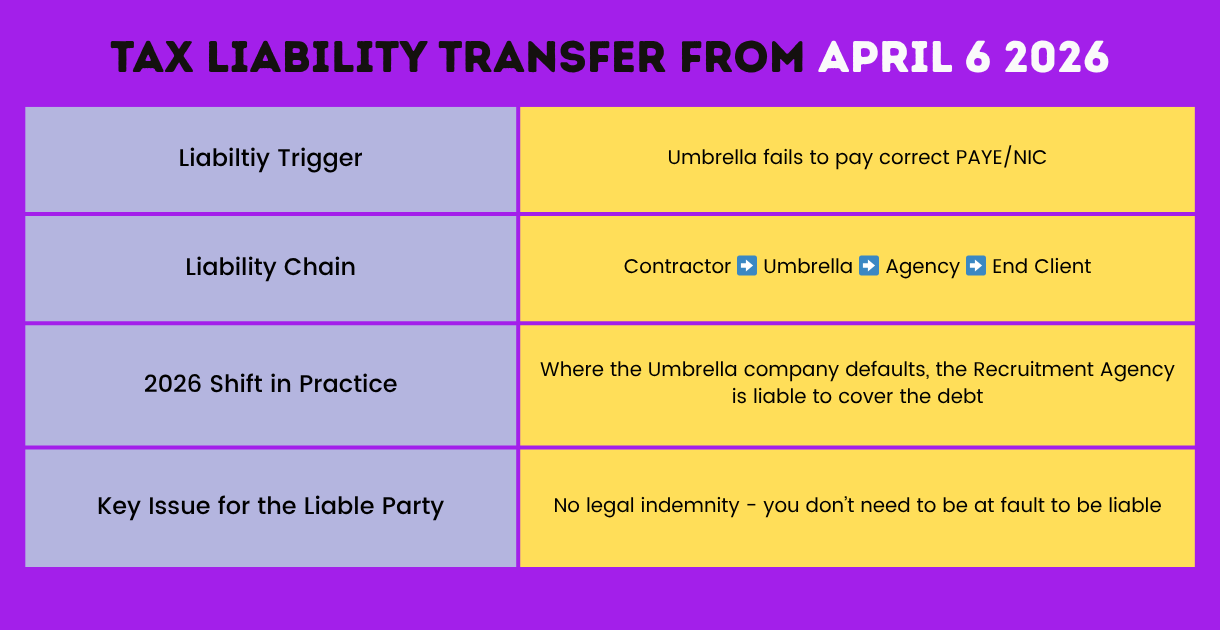
Previous changes to umbrella rules and off‑payroll working (IR35) legislation has understandably caused some concern for contractors. Each change has required learning and added admin to stay compliant. This time, HMRC has introduced joint and several liability (JSL). Effective as of April 6, the tax liability has been shifted up the supply chain: namely to recruitment agencies and clients.

How umbrella reform legislation affects recruitment agencies
So what is actually changing, and why?
Taxation compliance has never been straight forward for recruitment agencies and their contractors. It is a dynamic environment; with key changes to IR35 legislation being introduced and the emergence of the umbrella company framework.
Umbrella companies are employment intermediaries that employ workers on behalf of agencies and end clients. The number of contractors working via umbrella companies have increased significantly in the past decade, with IR35 reforms (aimed at putting an end to disguised employment) affecting the public and private sector in 2017 and 2021 respectively.
As the employment intermediary, the umbrella company must deduct the PAYE, employee/employer National Insurance, and the Apprenticeship Levy from the gross rate before remitting a net wage to the contractor.
The demand for umbrella companies to support the market has brought on the issue of non-compliant players, specifically the issue of umbrella companies engaging in “mini-umbrella” fraud or remuneration schemes. This has caused a big issue for HMRC and contractors: where an umbrella company cannot pay or simply ‘disappears’, there has been no way for the HMRC to recoup the missing funds.
To root out these bad players, any failure of an umbrella company (whether direct fraud or not) to pay the correct amount of Income Tax and National Insurance to the HMRC will now trigger the liability transfer to the next party in the supply change. In most cases, this will fall to the recruitment agency.
Staying compliant with umbrella company regulations
As technology and transformation recruiters we have a long history of working with umbrella companies. In our experience, working with legitimate and informed umbrella companies can be hugely positive and reassuring for all parties involved. That includes us, our clients, and ultimately our contractors.
Under the new legislation we are required to evidence how we monitor tax compliance in our supply chain. Crucially, under the umbrella legislation April 2026, acting in good faith does not prevent recruitment agencies from being liable. Agencies can still be faced with a retrospective tax bill if the umbrella companies they engage with commit fraud or make errors in payments and deductions.
As there is no legal indemnity, we have implemented changes to strengthen our due diligence process. This will also help us show HMRC that we have taken reasonable steps to ensure contractors are paid properly and in line with tax law.
Consolidating our PSL (Preferred Supplier List)
In the past, the companies on our PSL had to be FCSA Accredited as well as meeting other baseline compliance requirements. Our new PSL is much shorter. This is a deliberate choice; a shorter list of trusted suppliers ensures tighter control and oversight. For example, having certain accreditations alone is no longer enough. All preferred suppliers are also subject to providing us with proof of RTI (Real Time Information) submissions to HMRC.
Compliance Framework
Before April 6, we carried out a full audit of all umbrella companies we work with.
We now follow an ongoing compliance framework that combines real-time monitoring with quarterly reviews. This will help us continue to monitor and evaluate our supply chain going forward. The framework includes:
- Ongoing SafeRec monitoring across all umbrella companies to ensure real-time compliance and transparency
- Specialist Orbio Insurance cover via SafeRec to provide a robust financial backstop against HMRC joint and several liability
- Quarterly umbrella audits, incorporating checks via CreditSafe, SafeRec, FCSA, FCA and Companies House
- Completing umbrella director due diligence checks, including background and directorship history reviews
- Undertaking anti-money laundering (AML) checks to identify financial risk and ensure regulatory compliance
- Reviewing Companies House records to authenticate company status, filing history, and governance structure
- Cross-referencing compliance against FCSA accreditation and industry standards
- Strengthened financial and regulatory due diligence processes using multiple independent verification sources
Membership bodies - expert resources
Supporting our contractors and clients is our top priority. To stay informed and to offer the best advise possible, we use our memberships with APSCo and TRN. These memberships give us access to expert advice and guidance on changing legislation facing the recruitment industry.

How the changes impact our Contractors and Clients
In short, disruption is minimal. We have done the groundwork, led by our in-house compliance team in consultation with our finance advisory firm, industry bodies, and SafeRec.
Current contractors were consulted and transferred to an umbrella company of their choice on our updated PSL prior to April 6, where necessary. New contractors are directed to this PSL.
As liability shifts up the supply chain, we have also worked closely with clients. Where a client engages directly with an umbrella company, the liability sits with them. This makes due diligence and a trusted PSL critical for anyone deemed as the employer. Helping our clients has been an important part of our legislation readiness.
Internally, our compliance team has trained our technology recruitment consultants on the updated vetting process and the risks of non-compliant providers.
To Conclude
At Bright Purple we welcome the reforms and believe this will strengthen our relationship with truly compliant umbrella companies and help level the playing field in the umbrella market.
While we have spent months preparing for the new legislation, it is important to note that it has only just come into effect. We will continue to monitor how it plays out in practice.
Supporting our contracts and clients through IR35 changes is not new to us; with each change we have always worked closely with experts and stakeholders to ensure we protect our business and customers.
Hiring?
Are you currently building your team? If you are looking to grow your business using contractors - get in touch. Partner with Bright Purple to get access to the best talent and full support around all contractor legislation. Get in touch today to learn how we will help you scale.